In The Pummeling Pages, Brent Simmons sums up the experience of reading on the web, which is something I’ve become increasingly frustrated with as well:
I was there because I just wanted to read something. Words. Black text on a white background, more-or-less. And what I saw — at a professional publication, a site with the purpose of giving people something good to read — was just about the farthest thing from readable.
The site has good writing. But the pages do everything possible to convince people not to try. “Don’t bother,” the pages say. “It’s hopeless. Oh — and good luck not having a seizure!”
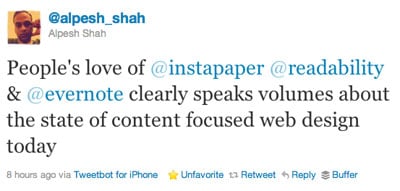
I see the sentiment echoed everywhere, including tweets like this one by Alpesh Shah:
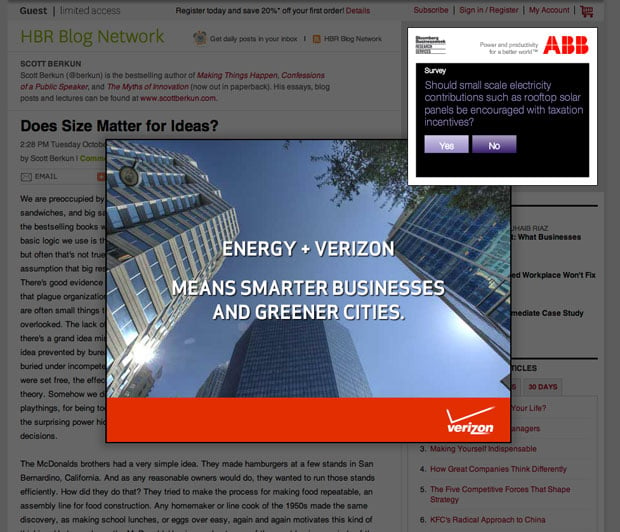
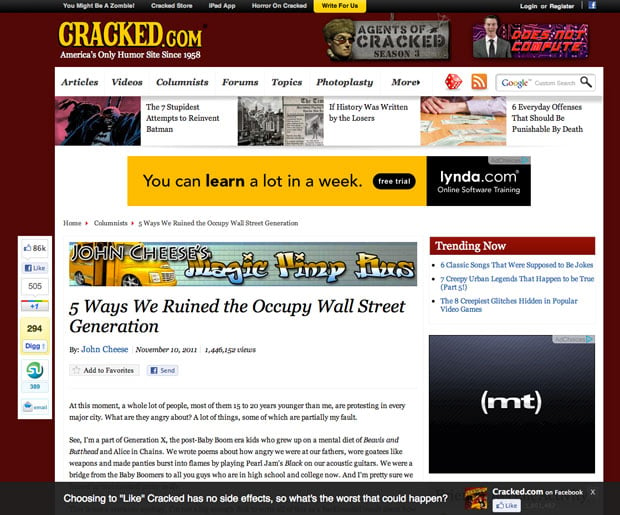
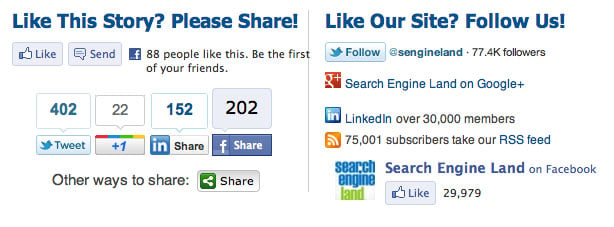
Just to be clear about what we’re talking about, here are a few examples that illustrate why there is such a growing frustration with reading on the web.
First, here is an article on Harvard Business Review that not only blocks me from reading anything until I click to dismiss the ad, it also messes with the other ads on the page:
Here’s a story from Cracked.com, where in my unscientific estimation about 15% of the page above the fold is devoted to the actual text of the article:
And finally, an example from Search Engine Land that illustrates the following sentiment in Brent’s article:
They’re filled with ads and social-media sharing buttons — and more ads. And Google plus-onesies and Facebook likeys. And also more ads. Plus tweet-this-es. Plus ads. (And, under-the-hood, a whole cruise-ship-full of analytics. The page required well-more than 100 http calls.)
Is this the future of reading on the web? I sincerely hope not. I keep reminding myself of these words by Jeffery Zeldman:
Most of all, I worry about web users. Because, after ten-plus years of commercial web development, they still have a tough time finding what they’re looking for, and they still wonder why it’s so damned unpleasant to read text on the web — which is what most of them do when they’re online.
The scary thing is that Zeldman wrote that in 1999 (he revised the post slightly in 2005). And many years later the experience of reading text on the web seems to be getting worse, not better. As I wrote in The demise of quality content on the web, I’m worried that the wells of attention are being drilled to depletion by linkbait headlines, ad-infested pages, “jumps” and random pagination, and content that is engineered to be “consumed” in 1 minute or less of quick scanning – just enough time to capture those almighty eyeballs.
As advertising clickthrough rates continue to drop, the ads become more desperate and invasive, and readers are starting to notice and do something about it. I’m doing the majority of my reading in RSS and Instapaper where I can read in peace without being pummeled by distractions.
The thing is, there are better ways to make money from writing – ways that are more respectful of readers. Ad networks like The Deck come to mind, as well as the growing number of sites that offer memberships (like The Loop and Daring Fireball).
It’s time for publishers to think different.


{ 80 comments… read them below or add one }
← Previous Comments
the irony is that I had to try three browsers to actually be able to read your article. both opera and firefox refused to load the referenced images, without which the article is, well, not a good read.
@tech-no-logical: It is possible to read the article easily without the images. Blame amazonaws or something in between, there’s nothing wrong with an article having images.
Probably your content blocker/AdBlock hidden them because of “ads-” in the file names.
you are correct. the original point being made (content becoming unreadable) is the number one reason for me to use such software though. is that irony then ?
Thanks guys – I removed the “ads-” from the file names – should be good now.
No, it’s just bad configuration. It would be ironic if it caused you to see more ads.
+1
)
See also Zeldman on irony: http://www.zeldman.com/2011/11/18/it-is-not-ironic/
hmm not a huge deal but ironically follow butons follow the window of the user on your site too
I think some of the publishers are starting to understand that they may print more ads but they also lose involvement.
When I look at a website like Grantland’s, backed by ESPN which is as Big Media as it gets, it makes me optimistic.
> The scary thing is that Zeldman wrote that in 1999.
I doubt that Zeldman wrote this in 1999, because “ten-plus years of commercial web development” was not possible at that time. The web was not widely in use before 1993, the first big commercial sites appeared around 1995/1996 (HTML 2.0 was brand new, no tables, no Javascript (too new, too unstable)).
The original was written in 1999, but he revised it slightly in 2005 – see http://www.zeldman.com/2010/12/18/style-versus-design-revisitd/. Good call-out though – I revised the post to reflect this.
The images don’t open in chrome. I had to use IE tab to get them to work.
Regarding the subject, you touched on the spot. There are sites other than those mentioned that are even worse and a lot more frustrating to read. Some split the article into pages where you have to click ‘next’ forever. Others insert ads in between paragraphs or ads that are floating. I hope this isn’t where the web is going since it’s a big mess.
It’s probably because you run an ad blocker and the original filenames had the word “ads-” in them – I fixed that now, images should work.
exactly why I built pen.io
The only solution if you want a quality content delivered and/or displayed in a nice brain-friendly manner is to to be willing to pay for it. And the payment too has to be frictionless, on-demand, as you go — fortunately, there are providers who offer this.
Check out Znak it!
Check out the “Flipboard” app for the iPad. It’s *beautiful*, and completely reader-focused. And, yeah, ad-supported, but just like magazines, the ads are between pages, and so you flick past them just like a full-page ad in a magazine… yeah, it’s there, but it isn’t covering up content or animating in your face.
It’s also important that the text reflows to fit the screen no matter how much you magnify it. The current page doesn’t do that successfully.
Sadly this is why we use reader like Google Reader (which they’ve messed up after the UI revamp).
The web’s content is starting to feel like urbanisation – people move to the rich and quiet neighbourhoods to get away from the crummy inner city (which was fine once upon a time).
The sad thing is that good web devs spend so much time to create good sites that focus on content. But due to how the web is developing (full of ads etc.), their sites now also end up in our RSS readers, strippped of the experience they worked so hard to create.
“The page required well-more than 100 http calls.”
You can imagine the situation when someone just wants to read the article, while on a slow connection.
Someone just made the following comment on Reddit:
I just did a quick test.
* A random Cracked article without addons: 238 HTTP requests, 2.88 MB
* With AdBlock + Ghostery: 51 HTTP Requests, 1.3 MB
That means 55% of all data is just ads and trackers we don’t really need.
(via Reddit)
The Complete Works of William Shakespeare (in EPUB format): 2.3 MB.
http://www.gutenberg.org/ebooks/100
That is a very telling observation.
That’s the problem with big publishing companies with greedy leaders.
Independent bloggers use beautiful and useful ads from Fusion, Carbon, The Deck, BuySellAds, etc. The web would become much better the day a major publisher would sign up for one of these networks.
And I guess the best proof of this isn’t people’s love of Instapaper and Readability. It’s Apple shipping Reader in Safari.
Also, Instapaper’s main feature for me isn’t the extraction of content and removing crap. I use it for offline reading, position saving, sharing and archiving. So, it’ll be still needed after reading on the web will become better.
The ads served by BSA, The Deck, Fusion etc are “nicer” in that they’re notionally better designed and a bit more relevant to target market but honestly how often do people click those either? Not much I bet.
There are so many of these ad networks starting up, and they keep adding sites to their networks, so it looks to me like it’s quite successful. Too bad we don’t have some actual data on that…
Rian, great post. We at Skim.Me agree completely and this is the exact problem we’re trying to help solve. We’re early but would really love to get your thoughts on how you find reading text on our site (http://skim.me). We’re creating one feed of all the sites you routinely check. I’m a co-founder and you can drop me at note at wu [at] skim [dot] me if you have the chance.
Chrome + AdBlockPlus. It’s free and it gets rid of 99% of the ad crap on the web. You will not regret it.
Absolutely agree with you (and Brett’s original post), but the whole discussion seems short on solutions. You mention The Deck, which is great, but it isn’t going to work for small publications (it’s invite-only and base its invites at least partially on traffic) and at the other end of the spectrum, big publications already have their own in-house ad setups… (which is another symptom of the problem, the vast gulf between the ad salespeople and the writers/editors actually producing the content). The Deck serves a sweet spot somewhere in the middle, sites like Daring Fireball or The Morning News, but that doesn’t mean it works everywhere. Ditto for other similar networks like Fusion Ads.
At least part of the problem, it seems to me, is that there aren’t a lot of alternatives to the reader-hostile ad revenue you (rightly) call out.
We’ve recently launched TipTheWeb.org , and hope to be part of the solution. TipTheWeb lets you support the stuff you like online by tipping it, e.g. give 10 cents for a blog post you like, and is an alternative monetization strategy to advertising for web publishers. We’re non-profit, and our mission is to improve the quantity and quality of freely-accessible content on the Web.
I’ve tipped this very article 20 cents already
, which you can see on my Tip Stream here: http://tiptheweb.org/tipstream/patg6vy3pyb62/
Dave-
Good to see someone tying something. I applaud that for sure. But while the
micropayment approach might work for blogs, but they aren’t going to work for big publishing companies, who are often the worst offenders. I appreciate what you’re trying to do (and Readability is doing something similar), but part of the problem — and I know this because I work for a big media company that uses the annoying, intrusive ads we’re all decrying here (which is why I’m posting anonymously) — is that the systems in place are difficult to remove. I tried to sell my bosses on the Deck (didn’t work, we have an in-house ad networks with thousands, if not millions already already invested, tough to change something when, from the purely bottom-line perspective, the status quo works for publishers). A membership system would require infrastructure changes and a total rethinking of the entire system. That’s not something that’s going to happen overnight. In short, the status quo works, it makes money. And that makes it very tough to convince publishers that something needs to change. Over the long run current practices are hurting publishers because they’re alienating their readers, but publishers are only looking at the bottom line, and, at the moment, they’re not seeing that hurt yet.
What scares me is that publishers aren’t going to wake up to this problem until it’s too late to pivot to something new. I have no idea what sort of impact it would have, but it might be worth writing some of your favorite publishers and telling them, hey, I had to stop reading your site because it’s so deliberately hostile to reading. Sad as it is to say, many of them simply don’t see the problem.
I appreciate your comments None (from a big publisher). They ring true. Back in 2008 when we started pitching publishers about other, better, ways of content monetization (including small or nano payments; they can work for large publishers as well), we received a unanimous “no way,’ even though most of our interlocutors were well aware of the changes in the marketplace and willing to admit that advertising might not be enough to sustain their online presence. Still, they were rejecting anything other than ads. One of our contacts then, had the guts to explain why: publishing is run by advertising guys and they see the other streams of revenue as undermining their role. Most journalists are against direct payments as well. Imagine one or two popular columnists receiving all the tips or on-demand payments, and the rest of the writers close to nothing.
Greg, in your opinion could it also be that
(1) the infrastructure and knowhow to distribute ads is well explored, and
(2) [enough] ads are sold on fear and disinformation — creating the impression that “if we DON’T advertise, we’ll be crushed” or “half of my ad spend is wasted, I just don’t know which half”
?
As with Readability, I’m curious if the sites being tipped have signed up with you or whether you are taking the liberty of collecting tips on their behalf – and if so, what happens to tips that are never claimed by publishers?
Essentially, this: http://brooksreview.net/2011/11/readability-agency/
With TipTheWeb, Tips that remain unclaimed for a long time are eventually returned to the tipper, so the funds can be used for new Tips. We don’t just keep the money
None, this discussion is starting to remind me of how we heard in the late 90′s that Targeted Ads were going to generate more revenue and be less intrusive to users. I still don’t feel like we’re there (probably not even closer, not even on Facebook which knows way too much about me).
Try accessing the mobile version of a site/article instead, as they are typically not nearly as Ad-laden and hopefully they’ve minimized the number of images, widgets, and assorted sharing do-dads in consideration of minimizing bandwidth/user mobile data bills (but maybe not, depending on design/dev team).
To make the switch you can either figure out the site’s mobile URL scheme and simply use that instead, or, if they do redirection you might require switching your User-Agent, using something like the FF plugin:
https://addons.mozilla.org/en-US/firefox/addon/user-agent-switcher/
Also, tools like popup blockers can help too but beware of spyware that ironically enough comes with some of these tools themselves.
Well, there’s some nice content at my chapbooks.co.uk, where social networking is an alien concept.
None says the discussion is short of solution. To the contrary, it shows lots of people and businesses trying to help readers and publications to create a better “reading environment.” But I guess it is a lot easier to complain than try something new.
I kind of understand the big publishers; they are used to advertising and huge ad accounts with no effort to sustain and huge parties/bonuses to keep then coming back. But he readers? Specially those who claim to be intelligent and discerning , they should know better. There are tons of resources to get news/mags, books, music, video — what have you — of high quality and without annoying ads; no basis for complains here.
Maybe its just the evolution of media. It wasn’t long before ads were on TV. Then there were more ads. They they had goofy animated ads on the TV WHILE THE SHOW IS STILL ON!
If you could Facebook from your TV the Remote would have a Like button.
Completely agree. Some sites are getting ridiculous with the amount of ads on them. That’s why i do most of my reading through google reader (it just sucks for feeds that don’t provide the whole article so i have to click through).
Just now, i clicked a link to read a NY Times article and i see this crap: http://i.imgur.com/cXVsQ.png
god dammit.
Is it ironic that I find your page a pain to read until I disable CSS because you choose to use a too-small font (and I haevn’t bothered to check, perhaps you called out a font that didn’t render well, though serif fonts are always hard to read in small sizes on the low resolution of a monitor)? If it is, then most of the web is ironic, I guess.
I use Georgia with a 15 px font size, and black text on a white background. I’d love to see a screen shot of what it looks like on your screen, because it seems strange that you’d call a 15 px size too small.
Martin, why not just type Ctrl + ?
Readability and paper.li are other new alternatives to ads.
But, can you really be mad at people for trying to make a buck from their writing? No-one wants to work for free. More people are reading and fewer people are paying to do so. Even the NYT is having trouble getting money for its world-class content.
I’m not saying people shouldn’t make money from writing, I’m saying that there are better ways to make money (see last two paragraphs and the other article I link to there).
I hear you there. But New = Risky and Unproven. I just meant that — given that web surfers are so averse to paying for anything — I can forgive the screamy ads that hog up memory.
I see the NYT struggling to charge 99 cents per month for world-class content.
Media consumers complain if the ads are too loud, they go somewhere else if they’re asked to pay, and in other ways too I think we readers demand a lot without giving back.
I do most of my reading on wikipedia. To re-use a common phrase, Users interpret advertisements on the internet as a defect and route around them.
Jerry, did you ever donate any money to wikipedia? They don’t show ads but they rely on individual donations to pay for the bandwidth and the servers. Very few people do. It is very sad that some pay $4.99 daily for their latte while they put up with these ads in order to avoid paying $5 for anything on the web (maybe even for a monthly subscription. We’re getting what we reward. Vote with your wallet!
Harvard Business review is the worst! It’s like they major in doing everything wrong. I signed up for a free web-seminar they were doing (thank you!), that they advertised in their Facebook feed.
1. I clicked the Facebook link. It took me to a product page, where I had to put the free product — the seminar — into a cart.
2. I had to set up an account, wanting all the usual information.
3. I was then bounced back to their home page. I had to go back to Facebook to find the link to the seminar again.
4. I’m pretty sure there was no seminar-specific thank-you page, or follow-up email (could be wrong on that?).
5. They posted two times for the call on their Facebook feed, I had to ask for them to correct and clarify.
6. I missed the teleseminar and couldn’t watch the replay (which came out over a week later) on an iOS device. Flash REQUIRED.
7. I also couldn’t download the presentation or download the audio. Only allowed to watch it at my desk, with flash installed. Okay, that makes sense. NOT.
I really like HBR. GREAT magazine. But their web presence is insane! I hope they get it together.
Use Privoxy with the perl script that parses ABP lists and run it on a crontab to update it. I set this up for my work and everyone loves it.
Ads are for suckers.
Also, I wish more websites were better with accessibility — that way I could use Lynx for browsing (and it also, you know, lets people with disabilities read your cruft — not that any sites worth reading are doing this garbage to excess)
You don’t even mention how terrible news companies web-sites are. Look at The Huffington Post, I love the articles but the site layout itself is nothing short of horrific. Same can be said about FoxNews or Cnn. Not to mention major player’s affinity to jam videos down your throat, when I can read a 15 minute video in 2 minutes. Unfortunately, I believe literacy is going to take a major nose dive.
And I can’t read what you wrote on your site without having to use my browser’s horizontal scrollbar… left to right to left to right to left…
What resolution are you on? The site should fit any resolution higher than 1024×768.
That’s why I use Firefox with RequestPolicy. It kills all other HTTP requests by default and then only allows those you allow explicitly. The web is much nicer place since I use it.
Just look at the Huffington post. I’d also consider their site a content farm, their site crops up in numerous web searches I make.
How about the basics… I hate the trendy gray on white text these days, and I’ve always hated reading page after page of white on black. Gray on white makes me squint to read it. White on black ruins my eyesight for 5 minutes after I STOP reading it!
This is the reason I created Letterloom.
I wanted a space for easily editable, shareable pieces of text that would make for easy reading on the web. Start writing or paste text, watch the URL change, share that loom with others, who can read it. You can keep writing in/changing the loom at that URL as long as you created it (which is tracked with a browser cookie – all of the looms associated with your browser cookie will show up in a sliding hover-shelf on the right, all looms which you can load and edit at your leisure).
There is no reason you couldn’t publish a short story on Letterloom. (Google it?)
No surprise, most “news” sites these days are designed as “let’s cram a page completely full of ads, and then shove a news article in somewhere so people will actually look at it”.
Here’s one of my personal favourites: http://imgh.us/how_not_to_design_a_site.jpg
…and notice that’s with AdBlock. I don’t even want to know how it looks without.
Hi, I am Katja from paperC, Berlin start-up.
We hated what web did to reading, that’s why we created a reader for textbooks and now enable students to READ on our platform all the good stuff publishers will let us deliver to them. right now we’re testing our next baby, EPUB reader paperc.com will launch next week and once we got started, our vision is to enable everyone to filter fuck from focus. And best: no scrollbars on no device.
looks like I forgot: the app will not be working for text books only. once we got it up and running, paperc will become a publishing tool and content filter all in one. Make reading on the net a pleasure, folks.
I have a Mac and Safari allows me to push the “reader” button and just get the text of the article along with any pics. It’s great! No stupid plugins.
Wow, great work guys. Can’t see the images.
Hi Richard – I had some trouble with adblockers because I originally had the word “ads-” in my images, but that should now be resolved. I’m serving the images from Amazon S3 so it should come through fine.
That’s why I love some apps like FlipBoard and Zite so much..
Also the new Reader function of MobileSafari.
you don’t talk shit about cracked.com. never!
The thing I hate more than anything else are the margin ads – the background clickable guys that trick you into clicking when you click outside the main content area to scroll down. That’s just dirty.
It’s fine for the technically aware who are aware of, and can use, something like instapaper or Adblock to remove this added cruft, but the experience of normal users is being seriously damaged.
Cramming more ads onto a site is a symptom of a deeper problem.
These ads don’t work.
Users are subconsciously blind to them, and they damage brands that employ them. The real solution is to move to a cleverer, more targeted, holistic model for promotion, but vested interests and the existing print ad-sales model perpetuate the system.
It’s also going on in the larger culture. When I was a Canadian public TV (CBC) producer, a half-hour was 28:50. That left 10 seconds for station ID, and a minute for promos of the other CBC shows per half hour. In commercial TV, as I recall, a half-hour was somewhere around 25 minutes. That would mean you’d make the show about 24:50. Today, a half-hour show is 21 minutes, and they’re stunting by speeding up the end credits somehow. You can’t read them.
I think this breathless ADD transfers over to the editing style, and also, the subjects and styles. Reality TV about Kardashians, edited as crazily as an avant-garde movie in the ’60s, flash and jam-cuts, chopped to bits. Many of the shows I’ve worked on actually never allow a speaker to say one complete sentence in one complete close-up. Anything more focused in the content makes people really mad at the ads for interrupting. In a Kardashian show, what’s the difference between the show and its ads? There is none.
Please, I hope Steve Jobs had worked out the solution for that in the supposed Apple TV.
Exactly right. Coming from Europe, watching US TV is an extremely frustrating experience. I believe it actually serves to reduce people’s attention span. That is why teenagers can’t read books any more without constantly checking their phone.
The web is turning into the same thing. The only sites that will continue to be relatively clean will be the ones that sell everything they know about you – Google, Facebook, Twitter.
when I got to: “And finally, an example from Search Engine Land that illustrates the following sentiment in Brent’s article:” I thought (at first) “oh, that last image didn’t load” and “that was an abrupt end” because I didn’t really see the image except as a subliminal “this is the end of the article” signal.
Can’t read the images either – in Opera, FF or Chrome. Rian, that kind of messes all over your point.
Hi Angie – I had some trouble with adblockers because I originally had the word “ads-” in my images, but that should now be resolved. I’m serving the images from Amazon S3 so it should come through fine.
Thanks for all the comments so far, everyone. I just wanted to add a couple of thoughts around possible solutions (it’s encouraging to me that so much of the discussion is around what we can do about these issues).
I’m also a huge fan of Readability, but Ben Brooks recently got me to think twice about their business model and the idea of taking money on behalf of publishers without their consent. See his thoughts here: http://brooksreview.net/2011/11/readability-agency/
Also have a look at Oliver Reichenstein’s idea of “Business Class News” at http://www.informationarchitects.jp/en/business-class-news/
And then there are other models that appear to do well, like RSS feed sponsorships and, well, selling T-shirts
But granted, you need a lot of traffic to make that a viable business model.
Which brings us back to an important question – how do passionate writers make money off what they do without selling their souls to Google AdWords? How do you get to the traffic levels needed to get sponsorships if you’re not that into headlines that start with a prime number or end in a question mark? (See http://en.wikipedia.org/wiki/Betteridge's_Law_of_Headlines).
If someone has an answer, please speak up!
When Web readers are willing to pay a fair price to read quality content so publishers can pay writers to create it, then advertising gimmicks might subside.
In another context the content providers would convince the governments to subsidize them.
As publishers: yes, think different.
As readers: pay up, or shut up.
I read the first few sentences of this article and then skimmed the rest.
I think I agree.
But you were a bit wordy and my attention wandered.
Couldn’t agree more. Lazy writing (such as “Top X” lists) and a terrible reading experience (as showcased above) not only make reading on websites headache inducing, but I think it trains internet users to skim, browse, skip, and otherwise look over websites as fast as possible to avoid the pain of actually reading them. If they do actually want to take in information on a website it’ll take twice as long as it should. I’ve even had popup ads interrupt me while I was in the middle of articles.
{ 20 trackbacks }